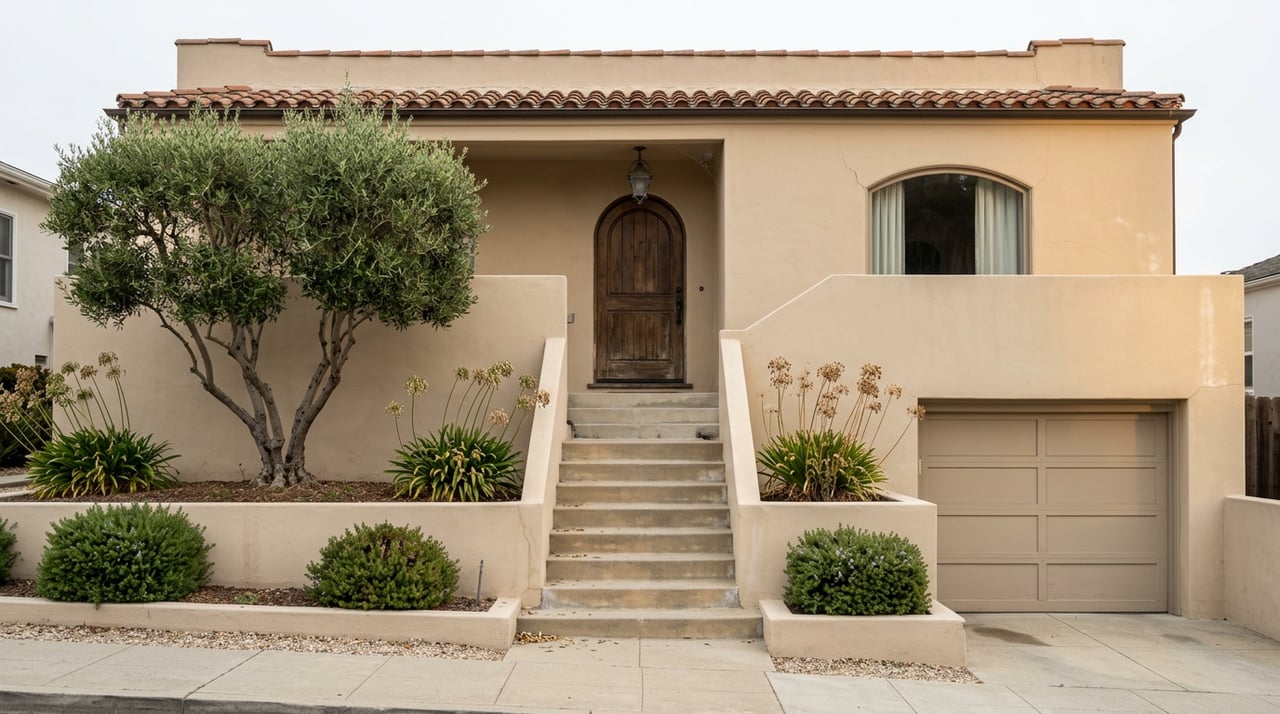
Open Redfin's West Portal page this month and the headline number stops you cold. Over the three months ending May 2026, the neighborhood's median sale price fell 34.5% year over year, down to $1.63 million. That is the kind of number that makes a seller nervous and a prospective buyer wonder if they should wait.
Then you check the sample size. Six homes sold in West Portal in May 2026. Thirteen sold in May 2025. A neighborhood built on rows of Marina-style, Tudor, and Mediterranean single-family homes just had its entire monthly market represented by six closings, and the median moved 34 points because of it.
The same report, two different stories
Here is the part that should give anyone pause before repeating that 34.5% figure at a dinner party. The same Redfin dataset also tracks West Portal's average sale price, and it puts that number at $1.8 million for the most recent month, down 12.2% year over year. A single source, covering overlapping windows in the same neighborhood, produced a 22-point gap between what its median and its average were telling buyers. That gap is not a market signal. It is what happens when a tiny sample gets asked to summarize a market that ranges from $800,000 condos to $3.5 million houses.
Zoom out to a source with a bigger sample and the ground stops shaking. Over the same three months ending May 2026, San Francisco citywide posted a median sale price of $1.7 million, up 16.1% year over year, on 1,668 closed sales in May alone, up from 1,448 the year before. Sixteen hundred sales smooths out a market. Six does not.
What was actually closing while the "median" fell
The homes that did trade in West Portal this spring were not selling for distressed prices. A few of the closings from the same window Redfin used to calculate that 34.5% drop:
| Address | Closed | Price | Beds / Baths | Square Feet |
|---|---|---|---|---|
| 715 Ulloa Street | Apr 24, 2026 | $3,150,000 | 4 / 2 | 2,635 |
| 100 Sloat Boulevard | Apr 1, 2026 | $2,100,000 | 3 / 3 | 1,595 |
| 25 Claremont Boulevard | Apr 24, 2026 | $2,000,000 | 2 / 1.5 | 1,557 |
Widen the lens a few blocks into Forest Hill, which sits in the same San Francisco realtor district as West Portal and shares its housing stock and buyer pool, and the pattern holds. 34 Dorantes Avenue closed May 22, 2026 at $3,575,000. 77 Ventura Avenue closed May 19, 2026 at $3,355,000. These are not the numbers of a neighborhood losing a third of its value in a year. They are the numbers of a single-family market that is still finding buyers willing to compete for it.
So where did the median come from. West Portal's housing stock splits sharply in two. On one side are those single-family homes on streets like Ulloa and Claremont. On the other side are condominiums in complexes like The Grove, across 19th Avenue from Stern Grove, where two-bedroom units have listed in the $799,000 to $900,000 range this year. When a monthly sample is only six transactions deep, whichever type happens to close that month decides the median, not the underlying value of anyone's house.
A citywide pattern, playing out in miniature
This split is not unique to West Portal. Across San Francisco this year, single-family homes in established, transit-connected family neighborhoods have generally stayed competitive, while condos have softened into a market with more negotiating room and longer marketing periods. West Portal happens to contain both product types inside one small Redfin boundary, and its monthly sales count is small enough that a shift toward more condo closings or fewer house closings can swing the headline number by double digits without anything in the underlying market actually changing.
The days-on-market data backs this up in a more useful way than the median does. Homes that sold in West Portal in May 2026 took an average of 22 days to find a buyer, up from 12 days a year earlier. That is a real, believable shift. Buyers are taking a bit more time, and sellers are getting slightly less urgency out of the gate. It is a signal worth pricing around. It is nothing like a 34.5% drop in value.
For what it is worth, at least one other listing platform pulling from current and recent activity puts West Portal's median home price closer to $1.89 million right now, roughly $250,000 above Redfin's three-month figure. Two data providers, looking at roughly the same slice of the same neighborhood, landing that far apart is itself the point. When the sample is this thin, the methodology matters more than the market does.
Why the neighborhood itself hasn't moved
Nothing about West Portal's fundamentals shifted between April and May of this year. The commercial spine along West Portal Avenue is still built around a small number of long-tenured operators, including Papenhausen Hardware, which the same family has run since 1936, and the Ambassador Toy Store nearby. The neighborhood grew up around the Twin Peaks Tunnel, opened in the early 1900s to connect the west side of the city to downtown, and the West Portal Muni station still anchors the K, L, M, and T Metro lines today, the same as it did last spring. None of that infrastructure or identity changed. What changed was which six houses happened to close in a single month, and that is a fact about sample size, not about the neighborhood.
What this means if you're comparing neighborhoods right now
If you are weighing West Portal against Noe Valley, Glen Park, or another inner-west San Francisco neighborhood using the median price you saw on a portal, ask how many sales sit behind that number before you treat it as a market read. A citywide median built on 1,600-plus sales is a reasonably stable benchmark. A neighborhood median built on six is closer to a coin flip weighted by whoever happened to list that month.
For sellers, the practical takeaway is to build your pricing strategy from true comparable sales like Ulloa Street, Claremont Boulevard, and Sloat Boulevard, not from a headline percentage that is really describing a shift in the mix of what sold, not a shift in what any individual home is worth. For buyers, the 22-day average time on market is the number worth watching. It suggests a market that has eased slightly from the frenzy of a year ago, without suggesting a market in decline.
Common questions about West Portal's price data
Does a falling median price mean West Portal homes are losing value? Not based on the closed sales themselves. The three months ending May 2026 included single-family closings at $3.15 million, $2.1 million, and $2 million, alongside condo product priced well under $1 million. With only six total sales, a shift toward more condo closings pulls the median down sharply without any individual home losing value.
Why do different websites show different median prices for the same neighborhood? It usually comes down to methodology and timing. Some medians are built from closed sales over a trailing three-month window. Others pull from currently active and recently listed inventory. In a small neighborhood like West Portal, those different approaches can land several hundred thousand dollars apart in the same season.
Is West Portal currently a buyer's or seller's market? It depends heavily on property type. Single-family homes on streets like Ulloa and Dorantes are still drawing competitive offers. Condominiums, particularly in complexes like The Grove, are moving more slowly and giving buyers more room to negotiate. Treating West Portal as one uniform market misses that split.
Talk to someone who reads the comps, not just the headline
A neighborhood median is a useful starting point and a poor final answer, especially in a market where six sales can carry the weight of a whole month. If you are trying to figure out what your West Portal home is actually worth, or what a specific comp set says about a house you're considering, Claudia Siegel works these inner San Francisco micro-markets block by block. Request a Home Valuation and get a read on your property built from the sales that actually match it, not from a monthly average that six transactions had to carry alone.