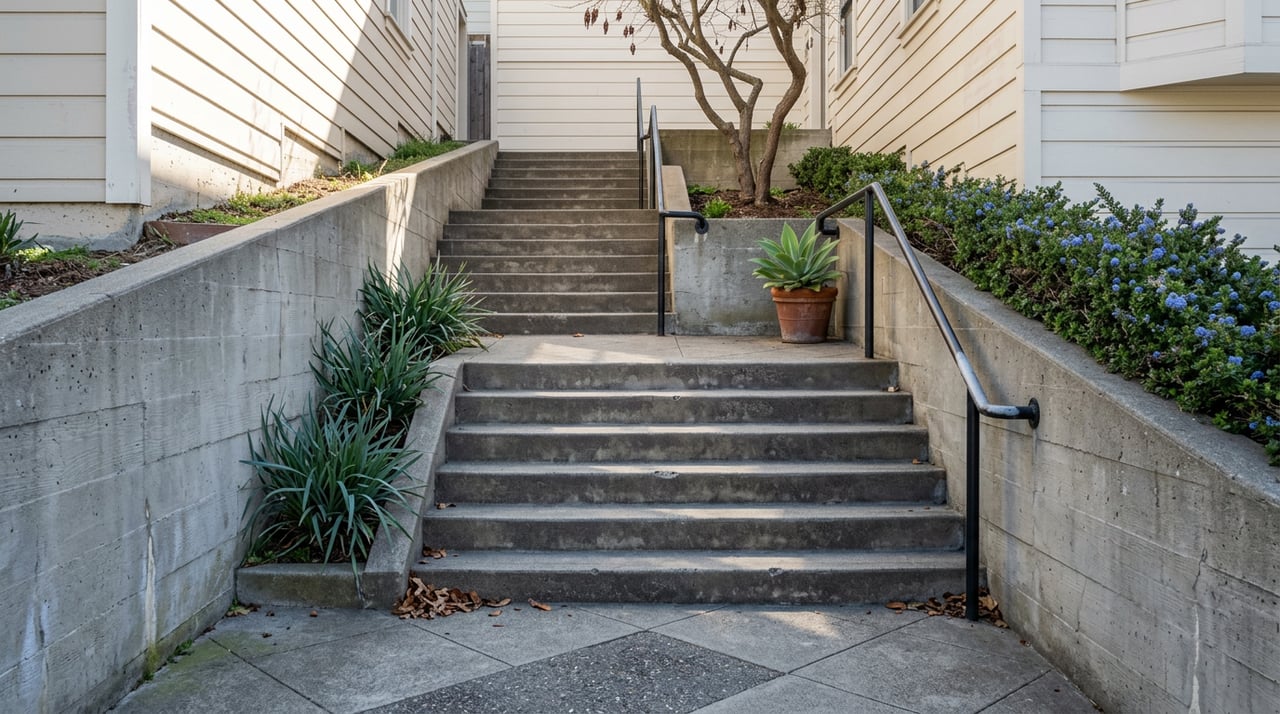
Walk 24th Street on a Saturday and you will see the version of Noe Valley that gets photographed: strollers, dogs, a line for pastries, the farmers market humming at the Town Square. It is a real street and a good one. But it is not where most residents spend their unstructured time. That happens above it, on a second network of routes that never shows up on a tourist map because it is made almost entirely of stairs.
Noe Valley sits in a bowl. Every direction out of it goes uphill, toward Twin Peaks, toward Diamond Heights, toward the ridge that separates it from Glen Park. Decades ago, instead of waiting for the city to solve that problem with switchback roads, residents solved it themselves with wood, concrete, and volunteer labor. The result is a set of named, mapped, still-maintained stairway routes that function less like scenery and more like the neighborhood's actual secondary street grid. If you have lived here a while, you already climb them without thinking about where they came from. Here is where they came from.
The Hill That Used To Be A Quarry
At the corner of 30th and Laidley sits Billy Goat Hill, a 3.5-acre outcrop that is one of the odder pieces of land in the city. It was not always a park. In the late 1800s and early 1900s the hill was a working rock quarry, run by a pair of brothers named Gray who supplied the gravel that built the streets of Noe Valley around it. The quarry closed, the land sat mostly unused, and in 1976 the city bought it. In 1995, San Francisco folded it into the Recreation and Park Department's Natural Areas Program, one of 31 protected pockets around the city meant to be managed less like a lawn and more like a remnant of what San Francisco looked like before the streets went in.
That designation did not mean the hill got easy. By the mid-2000s the trails were eroding into what neighbors described as a mud river at the base every winter. In the spring of 2009, two residents named Lisa and Muhammad Ghotbi revived a long-dormant volunteer group called Friends of Billy Goat Hill and organized a cleanup. More than 25 neighbors showed up to the first one. The group has run quarterly work parties ever since, cutting back invasive growth, resetting railroad-tie steps, and keeping an eye on the hill's population of California saxifrage, a native wildflower rare enough that it grows in only a couple of other spots in the entire city.
The city eventually chipped in real money. In 2010, using funds from a $185 million parks bond San Francisco voters had passed two years earlier, the Recreation and Park Commission approved a formal trail realignment for Billy Goat Hill, complete with new stairs and a retaining wall to stop the erosion at the bottom of the hill. Then in July 2016, a $150,000 project opened the Beacon Trail, a proper connector path linking Billy Goat Hill to Walter Haas Playground on the far side. What had been a scramble up a dirt slope became a route you could actually recommend to someone with a dog and a stroller.
A Field Guide To The Routes People Actually Take
None of this is secret to anyone who has lived here five years or more. But most residents know one or two of these routes well and have never connected them into the fuller picture. A rough guide to the network, moving from the most-used to the least:
| Route | Connects | What it's known for |
|---|---|---|
| Billy Goat Hill + Beacon Trail | 30th and Laidley to Walter Haas Playground | Steep dirt paths, a flat lookout plateau, and a rope swing tradition that outlasts every attempt to remove it |
| 22nd and Vicksburg Steps | 22nd Street's steepest block | An estimated 31.5 percent grade, steep enough that the sidewalk itself is carved into stairs rather than poured as a slope |
| Harry Street Steps | Off Laidley Street up into Fairmount Heights | Easy to miss, unmarked at street level, ends at a cluster of mid-century homes on the ridge |
| Pemberton Street Stairs | Romaine and Market up toward Twin Peaks | A longer climb with a small arbor partway up, used by residents who treat the summit as an extension of their own block |
That grade on 22nd and Vicksburg is worth sitting with for a second. A typical residential street grade in San Francisco runs somewhere in the range of 5 to 15 percent. At 31.5 percent, the block stops being a street you walk up and becomes one you climb, which is why the city poured actual stair treads into what would otherwise be sidewalk. It shows up in local hiking and stair-walk coverage as one of the handful of blocks in San Francisco where the infrastructure had to concede that a normal sidewalk was not going to work.
The Rope Swing Nobody Can Kill
At the top of Billy Goat Hill, two old eucalyptus trees have hosted a rope swing for longer than most current residents have lived in the neighborhood. The city has cut it down more than once, citing safety. It keeps coming back anyway, tied up again by whichever kids or neighbors happened to be nearby with a length of rope. It is a small thing, but it says something true about how this particular piece of parkland works. Nobody is waiting for an agency to maintain the fun parts. The same volunteer instinct that revived the Friends group in 2009 and shows up for quarterly cleanups is the instinct that keeps replacing the swing. It is community stewardship as a running joke that never quite gets old.
Fairmount Heights, The Pocket Nobody Fully Claims
Climb the Harry Street steps far enough and you land in Fairmount Heights, a small hillside pocket that both Noe Valley and Glen Park consider partly their own and neither fully claims. Its roots go back further than most of the surrounding neighborhood. The land was originally organized under something called the Pacific Railroad Homestead Association during the Civil War era, well before most of the Victorian construction that defines the flats below. Local historians have led occasional walking tours through the area precisely because its history sits slightly apart from the rest of Noe Valley's story, tied more to the ridge and the old railroad homestead plots than to the streetcar-driven development that filled in 24th Street decades later.
Reach the top of the Harry Street stairs today and the payoff is a small cluster of mid-century modern homes that look almost transplanted from a different decade, with peek-a-boo views back toward downtown on the climb up. It is the kind of detail that a resident who only shops on 24th Street might never see, because there is no reason to end up there unless you already know the stairs exist.
Why This Is The Neighborhood's Real Infrastructure
None of these routes generate foot traffic for a business or a headline about a new restaurant. That is part of the point. Noe Valley's commercial strip changes constantly, with new rooms opening and closing on 24th Street every season. The stairway network changes on a different timescale entirely. Beacon Trail is ten years old. Billy Goat Hill's volunteer stewardship stretches back to 2009 and, before that, to whenever the original Friends group first formed. The Harry Street steps and the Fairmount Heights pocket they lead to predate most of the neighborhood's current housing stock.
A resident who strings together Billy Goat Hill, the Beacon Trail, and a loop back down past Douglass Playground has done something closer to what this neighborhood actually offers than a lap around the farmers market. It is quieter, it does not require a reservation, and it depends on nobody but the people willing to keep showing up with pruning shears and a length of rope.
That is the version of Noe Valley worth knowing well, whether you have lived here for one year or twenty. The flat part gets the attention. The vertical part is where the neighborhood actually holds together.
If you are curious about a specific block, a specific stairway route, or what a particular corner of Noe Valley is really like to live on day to day, Claudia Siegel has spent decades walking these hills and knows which stairs lead somewhere worth going.